An adjustment as precise as the joint it's treating.
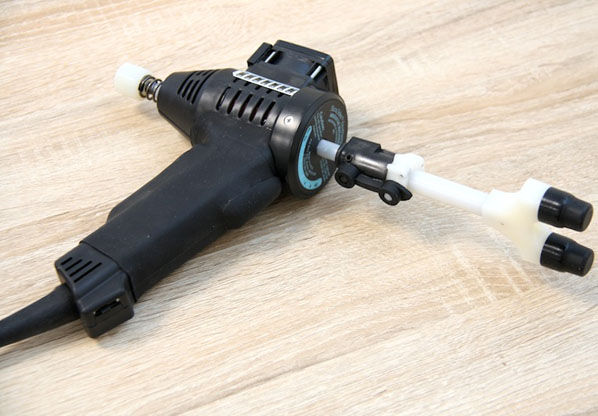
The ArthroStim delivers a series of rapid, gentle, computer controlled thrusts instead of one hard push, giving your provider a level of control that a pair of hands alone cannot match, without the twisting, popping, or holding your breath.
The real reasons patients hesitate, and where ArthroStim fits.
Traditional manual adjusting works by design, a single high velocity thrust that moves a joint past its normal range for a moment and back. It is safe and effective for a lot of people. It is also not the only way to move a joint, and for a meaningful number of patients and conditions, it is not the most comfortable or appropriate way.
The sound stops people from coming back
The cavitation pop is harmless, but plenty of new patients tense up at the thought of it, and that tension works against the adjustment before it even happens.
Muscles too guarded to release
Tight, protective muscle around a joint can block a manual adjustment from taking hold at all, leaving the same restriction visit after visit.
Joints a spinal thrust was not built for
A wrist, shoulder, ankle, or jaw is smaller and shaped differently than a vertebra, and twisting it the same way often is not the right tool for the job.
Bone too fragile for a hard thrust
Osteoporosis and thinning bone density call for a technique where force can be dialed down without losing effectiveness.
Hardware and healing tissue nearby
Post surgical spines, fusions, and healing tissue need a technique that avoids torque near the surgical site altogether.
A body that is already changing
Pregnancy shifts posture, joint laxity, and balance week to week, and calls for a technique that can adapt around a growing belly.
Frames too small or too delicate
Children and elderly patients often need the same relief as anyone else, just delivered with a fraction of the force.
Pain that keeps returning after one thrust
Chronic, recurring pain sometimes needs a repeated, rhythmic input rather than a single event to make lasting progress.
Jaw tension and related headaches
TMJ discomfort and tension type headaches respond well to small, directed impulses at the jaw joint and surrounding muscle, a spot manual adjusting rarely reaches well.
Knots that will not release with pressure alone
Trigger points and myofascial knots often respond better to rapid rhythmic input than to sustained pressure or a single manipulation.
Avoiding care altogether
Some patients skip chiropractic care entirely because of what they assume an adjustment will feel like, and go without relief as a result.
Overused joints in active patients
Athletes and physically active patients often need frequent, low load attention to the same joint without the cumulative strain of repeated high velocity thrusts.
How a handheld instrument replaces a single thrust with a rhythm.
The ArthroStim is a percussive, spring loaded instrument that delivers a rapid train of small impulses, up to roughly twelve per second, directly into a joint or the surrounding soft tissue. Your provider sets the force and speed for the specific joint and the specific patient in front of them.
-
1
Repetition instead of force
Instead of one large thrust, the joint receives many small ones. The cumulative effect mobilizes the segment without needing a single high amplitude push.
-
2
A reflex response, not a forced one
The rapid, rhythmic input encourages the surrounding muscle to release its guarding reflex, the same protective tightening that often blocks a joint from moving freely.
-
3
Adjustable, joint by joint
Force output is dialed up or down depending on whether the target is a lumbar segment, a rib, a shoulder, or a jaw. A wrist does not get the same setting as a low back.
-
4
No twisting, no breath holding
Because there is no rotational torque involved, patients stay relaxed through the whole adjustment, which itself improves how well the muscle responds.
Everything this technique gives you, in one place.
Some of this you will notice on the table. Some of it is what the research says is happening underneath. Both matter.
What you will feel
- ✓ No popping or cracking sound, ever
- ✓ No forceful twisting, no bracing, no holding your breath
- ✓ Comfortable enough for a first visit or a nervous patient
- ✓ Quick, targeted, and finished before you know it
- ✓ Reaches shoulders, wrists, ankles, knees, and the jaw, not just the spine
- ✓ Gentle enough for children, elderly, pregnant, and post surgical patients
- ✓ Encourages tight muscle to release instead of forcing a joint through it
- ✓ Can revisit the same joint in one visit without added strain
- ✓ Drug free and non invasive
What the research backs
- ✓ Consistent, repeatable force from one adjustment to the next
- ✓ Force and speed adjustable to the specific joint and patient
- ✓ Lower peak force per contact than a manual thrust
- ✓ Comparable outcomes to manual manipulation in published research for common conditions
- ✓ Built on decades of instrument assisted adjusting research and refinement
- ✓ Documented reduction in muscle guarding response after use
- ✓ A technique doctors can layer into a visit alongside manual adjusting
- ✓ Suited to conditions where manual thrust technique is contraindicated
Instrument adjusting has a real research trail behind it.
Instrument assisted adjusting did not appear out of nowhere. It grew out of decades of research into how much force a joint actually needs to move, and how consistently that force can be delivered by hand versus by a calibrated instrument.
Studies using force plates and accelerometers to measure chiropractic adjustments have found that instrument delivered thrusts produce a more consistent, repeatable force and speed profile from one adjustment to the next compared to a manual thrust, which naturally varies with fatigue, angle, and patient size.
Instrument assisted techniques were developed specifically to deliver a lower peak force per impulse than a manual high velocity thrust, while using repetition to still produce a mobilizing effect on the joint. This is the same principle behind why the technique is used with osteoporotic, elderly, and post surgical patients.
Published clinical research on instrument assisted adjusting, much of it appearing in the Journal of Manipulative and Physiological Therapeutics, has reported improvements in pain and range of motion for conditions including low back pain and neck pain, in some trials performing comparably to manual manipulation.
A closer look at the research and reasoning behind instrument assisted adjusting.
Is ArthroStim the right fit for you?
Check anything that sounds familiar, it is worth bringing up at your next visit.
If even one of these sounds like you, mention ArthroStim by name when you call. Your provider will tell you plainly whether it fits your situation and build it into your visit.
What an ArthroStim adjustment actually feels like.
-
1
Evaluation first
Dr. McKinney checks the joint's range of motion and the surrounding muscle to confirm the ArthroStim is the right tool for that specific spot.
-
2
Positioning, no twisting required
You stay in a comfortable, relaxed position. There is no need to hold your breath or brace for a thrust.
-
3
The instrument does the work
You will feel a quick, tapping sensation, more like a rapid gentle knock than a push, as the instrument delivers its series of impulses.
-
4
Recheck and move on
Range of motion is checked again before moving to the next area or wrapping up the visit.
ArthroStim, answered plainly.
Most patients describe it as a quick, gentle tapping rather than pressure or pain. The force per impulse is far lower than a manual thrust.
Usually not, and that is by design. The joint is mobilized through repeated small impulses rather than one motion that produces the cavitation sound.
Published research comparing instrument assisted adjusting to manual manipulation has found comparable results for several common conditions. Dr. McKinney chooses the technique based on your specific joint and presentation, not a one size fits all rule.
Yes. It is common to use the ArthroStim on certain joints or muscle groups within a visit that also includes traditional adjusting elsewhere.
The adjustable force setting is exactly what makes it a fitting option for lighter frames and more sensitive tissue. Dr. McKinney sets the force appropriately for the patient.
Neck and low back pain, shoulder, wrist, ankle, and knee joint pain, TMJ and jaw tension, tight or guarded muscle, and trigger points all respond well to instrument assisted adjusting. It is also a fitting option for osteoporosis, pregnancy, post surgical spines, and pediatric or elderly patients.
That is exactly the situation ArthroStim was built for. Bring it up when you call and Dr. McKinney can build your entire visit around it if that is what puts you at ease.
Everything you were about to ask.
Straight answers, no hedging where we don't have to. If yours isn't here, ask us directly at your visit.
Yes. The tools we use are gentle and not invasive, and most people find the sessions relaxing rather than uncomfortable. Everything is supervised, and your plan is matched to what your exam shows, so nothing is pushed further or faster than makes sense for you.
It varies with the cause and how long symptoms have been present. Many people describe small changes, often in sleep or the intensity of the burning, within the first few weeks. Consistency matters far more than any single visit, and we measure again along the way so you can see what's actually moving.
No. This is designed to work alongside your existing medical care, not replace it. Keep seeing your physician and keep managing the underlying cause, that's a core part of neuropathy improving. We're glad to coordinate with your other providers.
Honestly, it depends. Nerve tissue can improve, especially when the underlying cause is addressed and the damage isn't advanced, which is exactly why we encourage people not to wait. In longstanding or severe cases the realistic goal may be relief and slowing progression rather than a full reversal. We'll give you a straight read after your exam.
Diabetes is the most common cause, but it's far from the only one, nerve compression, certain medications and chemotherapy, injuries, vitamin issues, and thyroid or autoimmune conditions can all play a part. Sometimes no single cause is found. Part of the exam is working out which of these is driving yours.
Coverage varies. Some parts of a neuropathy plan may be covered and others may not. Our front desk will walk you through what to expect, and can explain current program and membership options before you commit to anything.